Content
- Google Drive folder (Week 7): https://drive.google.com/drive/folders/1SGPVtieYclwlKnfH2l-nOB-cK_VI-hfl
- Google Slide presentation: "Week 7" slide presentation in folder
- Zoom link
LLMs provide learners the opportunity to automatically adapt content to their level of understanding and preparation. In this exercise, you'll take a difficult topic such as a research paper or an advanced technology, and ask an LLM to adapt it to your particular level of preparation and your style of learning.
Audience adaptation
A deep technical paper can be hard for non-technical audiences to comprehend. However, one may be able to leverage large-language models to adapt the original content to a different audience and format. The prompt below In this exercise, we will attempt to learn about the fundamental innovation behind LLMs from the paper. Adapt the prompt below to learn about a complex topic of your choice. The transformer architecture and its attention mechanism are seen as the seminal contribution that has led to the initial large language models such as ChatGPT. If you wish to learn about the transformer architecture, use the prompt directly.
Explain the transformer architecture and the concept of attention in large language
models in one paragraph two times: once to a 12-year-old and once to a college
freshman. Each explanation should be genuinely useful to that audience.  Use the
following article as a basis for the explanation: https://arxiv.org/pdf/1706.03762

If there is a concept that is abstract, attempt to ground it in a real-world
physical example.  Focus on why this matters, not just what it is.
- Add a slide that includes the prompt that you utilized and the output produced.
Format adaptation
Models can adapt content into an alternate format such as slides, audio, and video. Adapt the prompt below to have the model do so.
Provide a visual representation for how the transformer architecture works.  It
should target a non-technical audience.  You may utilize animation, drawings, and a
limited amount of text.  Use the following article as a basis for the explanation:
https://arxiv.org/pdf/1706.03762
- Add a slide that includes the prompt that you utilized and the output produced
While studying the original source content provides the highest level of detail on a subject for a student, it is sometimes the case that a summarized overview may be helpful in quickly developing a mental model or framework for the material. In this exercise, you'll use content you're familiar with (i.e. the slides from the prior weeks of the course), to test the utility and accuracy of models in performing this task. To begin with, create a notebook in NotebookLM and add one or two slide decks from the course to it. A link to the folder containing the slides is in this week's Google Drive folder. If you have alternate course content you'd like to try the exercise on, utilize it instead.
Mind Maps
A graphical roadmap of a course or a lecture can help students to retain the information presented more effectively. One mechanism for doing so is NotebookLM's Mind Map feature. Prompt the model to create a mind map of the content from the slides you have uploaded.
- Add a slide that shows the result
Interactive audio overview
Most students fear asking 'stupid questions' in class even if the instructor says there aren't any. One of the benefits of utilizing an AI tutor is that it won't judge you for the questions you ask. To show an example of this technique, prompt NotebookLM for a 2-minute audio overview of the content from the slides.
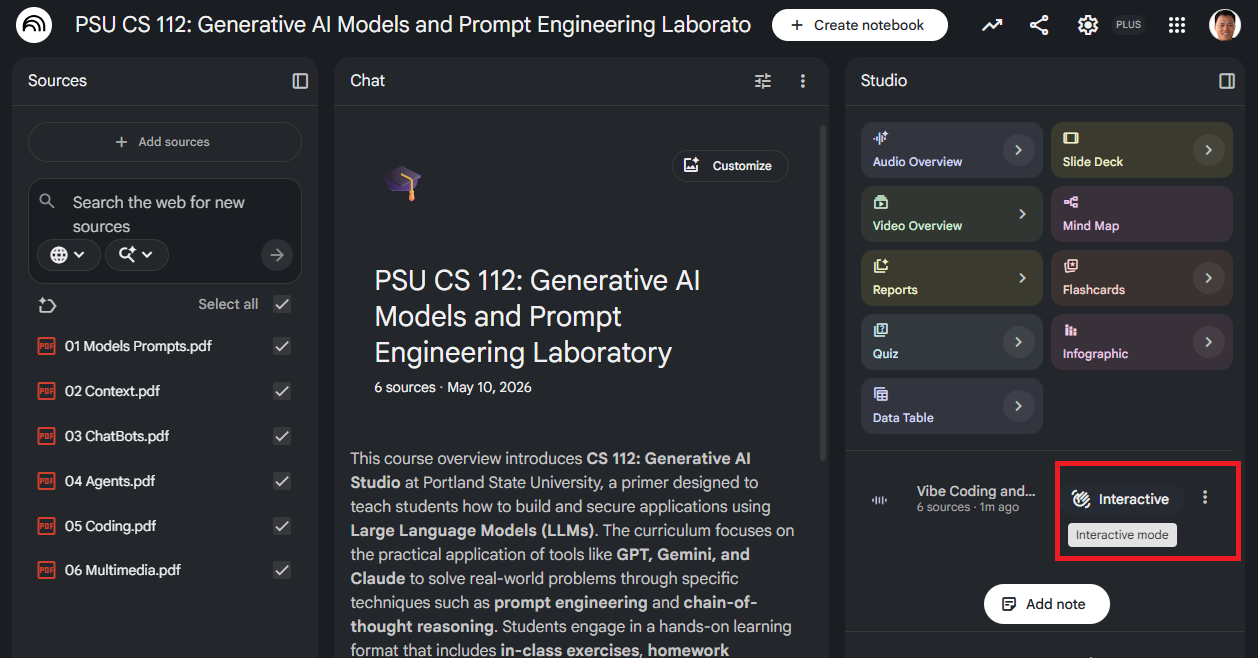
Then, while it is playing, utilize the interactive mode and join the audio overview conversation to participate in it.
Ask a 'stupid question' about the content or for clarification on a topic that you'd like more detail on.
- Add a slide that summarizes the results
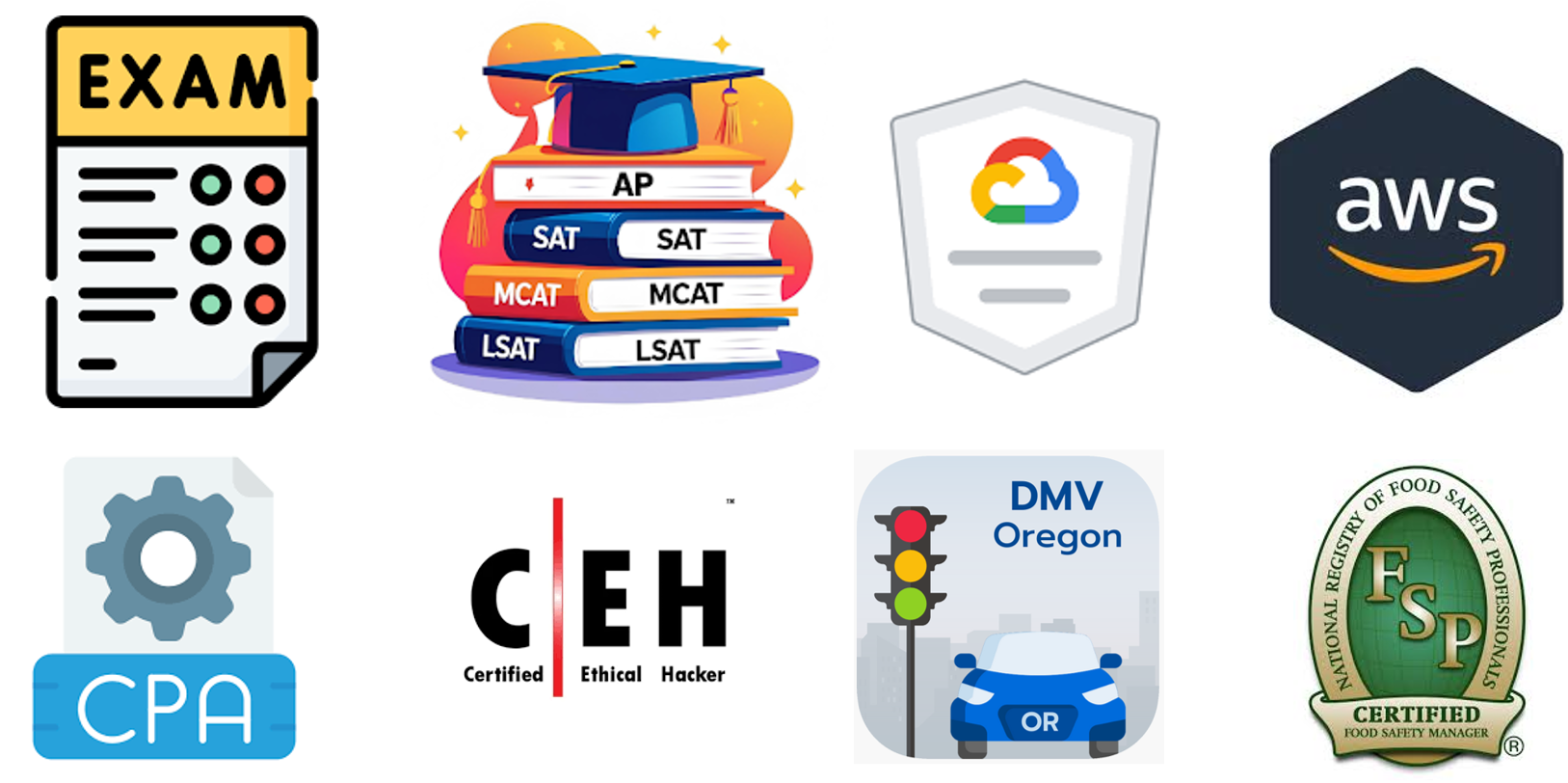
Many classes, schools, and agencies rely on exams for reliable assessment. In this exercise, we'll experiment with uses of Generative AI to help prepare for exams. To begin with, select a test that you might be preparing for. Options include:
- An final exam for any of your current courses
- Standardized tests such as the GRE (general), MCAT (medicine), LSAT (law), GMAT (business)
- Technical certification exams such as those offered by CompTIA, OSCP, Google Cloud Platform, and Amazon Web Services
- Non-academic tests such as the Oregon drivers license test or a food safety certification.
Prompt an LLM for source material that might help you practice for a standardized test of your choice. For example, you can utilize the prompt below.
I'm preparing for the <TEST>.  Find 3 sources of material I can include as context
in a notebook that would allow an LLM to generate flashcards and exams for me to
study for it.
Flash cards
Create a notebook in NotebookLM, add the source material, and generate flash cards.
- Add a slide that includes samples of the result.
Practice exams and quizzes
Next, utilize the context to generate personalized exams for you based on your mastery of the material and ask the model to provide an honest assessment of your ability. Adapt the sample prompt below for doing so:
Based on the study materials I've uploaded and the known style of the exam I'm
preparing for, please create an adaptive exam session following these guidelines
for 10 questions:

1. Present one question at a time, waiting for my response before moving on.
2. After each answer, provide the correct answer and a brief explanation. If my
answer is incorrect, offer a concise clarification.
3. Adjust the difficulty and complexity of subsequent questions based on my prior
performance.
4. Continue this process for the 10 questions.

After completing all questions, provide: a) A summary of areas where I might need
more review b) 3-5 key topics from the material that would be beneficial for
further study c) A brief assessment of my overall performance and understanding.
Throughout the quiz, be ready to offer clarification or additional information if I
request it. Please begin the quiz session now.
- Add a slide that includes samples of the result.

By supplying sufficient source material and prompts, LLMs can provide similar functions as applications that help people learn how to program. In this exercise, we'll experiment with learning Python from the source material found in Python.pdf in this week's Google Drive folder. From this material, we can prompt an LLM to tutor us in learning how to program in the language. With the help of an LLM, develop a prompt that can be used to configure an LLM tutor. As part of the specification, you may specify:
- Use of Python tools to validate code a user produces
- Teaching loop to use (e.g. introduce concept, show small example, give student a task to modify example, review student's submission and assess its correctness)
- Topics to cover
- Experience and difficulty level to initially use
- Support for adapting difficulty based on prior answers
- Use of images and visuals
- Tone and style of tutor
- Guidelines for suggesting hints
- Guidelines for delivering feedback
Then, kick off the programming tutor prompt and examine the result
- Add a slide that includes the prompt that you utilized and join the Zoom link to demonstrate the output.

With the ability to perform translation, produce speech, and implement flashcards, LLMs have the ability to implement many of the language learning applications that are out there such as Rosetta Stone, Duolingo, Memrise, and Babbel. In this exercise, we'll explore how well this can be done. To begin with, ask an LLM to generate a prompt that will allow it to act as a language tutor in the style of one of the above services. The prompt should include at least the following items:
- Language (Spanish, French, Japanese, Chinese, etc.)
- Method (translation, no translation)
- Content (grammar, vocabulary, conversational)
- Target level (beginner, intermediate, advanced, or CEFR level)
- Exercise style (flashcards, fill-in-the-blank, images, spoken language)
- Gamified design (scores, feedback)
Then, kick off the language tutor prompt and examine the result
- Add a slide that includes the prompt that you utilized and join the Zoom link to demonstrate the output.

Most services have support for a deep research mode that enables the agent handling user prompts to utilize a range of tools for accessing web sites and on-line articles as well as 'thinking' models that dedicate additional inference resources for performing the work. In order to develop a prompt that one can utilize in deep research mode, ask an LLM to generate a prompt that can perform a research task for you. The prompt should include at least the following items:
- A rapidly changing topic requiring up-to-date information
- Guidelines for types of sources to obtain the information from (i.e. web sites, PubMed, arxiv)
- Desired publication date ranges of the source material
- Minimum number of sources to retrieve, selection criteria for sources to utilize in developing the output
- Format of the output (i.e. slides, essay, thesis or academic paper with citations from source material)
- Length of the output
Topics can include:
- Current prompt injection vulnerabilities in LLMs popular platforms and their remediations
- Failures in LLM agents
- AI-assisted weaponry
- Feature and capability comparisons between current Generative AI services
- Feature and capability comparisons between top products in a category
Then, kick of research prompt and examine result
- Add a slide that includes the prompt that you utilized and join the Zoom link to demonstrate the output.
For homework, identify a challenging topic or skill you would like to become proficient in. Some examples might include:
- Large-language models
- Economic theory
- Retirement planning
- Agentic software engineering
- Personal finance
- Skills and tools in Claude, ChatGPT, and Gemini
Then, produce 3 artifacts to help you learn about the topic. Examples might include a tutor, an audio overview of research on the topic, an infographic, or a vibe coded application.
Screencast
Upon completing your project, via a narrated screencast of no longer than 5 minutes, you will perform a demonstration and walk-through of the prompts and artifacts produced. Ensure that the video camera is turned on initially in your screencast.
Rubric
We will be using the following rubric to evaluate your homework.
|
|
|
Submission
Upload your completed screencast on MediaSpace. Ensure that it is published as "Unlisted". Then, in Canvas, submit the URL that your unlisted screencast on MediaSpace is located.